 |
| Click for larger image |

Showing posts with label Google. Show all posts
Showing posts with label Google. Show all posts
Wednesday, 18 November 2015

Monday, 9 November 2015
Monday, 26 October 2015
Does Fogging work
No, it will not work.
In the long term control of dengue at least.
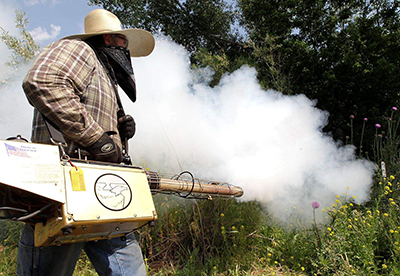
We have been fogging all our life. It is a well-known symptom of dengue. You can diagnose dengue from one kilometre away – by seeing the wafting fog filling up the air in your neighbourhood. It is so well known that people have become oblivious with fogging that they thought cigarette smoke can repel mosquitoes. Smoking is unhealthy. Fogging may save lives.
Despite the special effects that comes from your neighbourhood friendly fog men that look like Van Halen and Metallica making a theatrical entrance with a loud guitar roar and artificial smoke, the impact of fogging may not last, as you would, reminiscing the lingering effect of your first ever rock concert! For some, seeing the fog men at work create a false sense of security that whatever is causing the disease is under control.
Let us see some of the reasons why we should not depend too much on fogging.
http://www.mmgazette.com/7-reasons-why-fogging-will-not-kill-the-mosquitoes-dr-helmy-hazmi/
Monday, 19 October 2015
Dengue on the decline

PETALING JAYA, Oct 18 — Deputy Health Minister Datuk Seri Dr Hilmi Yahaya has confirmed that the number of dengue cases has declined in the country.
He said the number has been decreasing since the end of June.
“The country’s dengue problem is now better than before,’’ Dr Hilmi said yesterday.
The numbers fluctuated by a few hundred cases, but the trend is on an overall decline.
“The situation is improving and we feel the ministry’s efforts in eradicating dengue via multiple programmes are successful.”
He said the ministry would continue monitoring the situation and reminded the public that the problem was not eradicated.
“This does not mean we can rest, eradicating dengue is an ongoing effort by taking necessary precautions as advised.”
He also commended the ministry’s officers who educated people on checking their premises for possible mosquito breeding places, and stressed the importance of proper rubbish disposal.
‘‘Our officers go out of their way to raise public interest in combatting dengue.
“The public are more receptive, thanks to continuous efforts in promoting frequent clean-up efforts at residential areas, being present at fogging exercises and more.’’
Dr Hilmi said it was not that the public was ignorant of dengue, but they needed motivation to participate in eradication efforts.
- See more at: http://www.themalaymailonline.com/malaysia/article/dengue-on-the-decline#sthash.xCPe9HsB.dpuf
Dengue in Malaysia
Malaysia
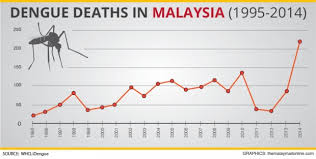
The number of dengue cases inch closer to 90,000 as the Malaysian Ministry of Health puts the dengue tally at 89,747 as of Saturday. Selangor state has reported 48,694 cases followed by Johor at 10,999 and Perak at 7,597.
The 2015 case count to date is approximately 20 percent higher than the same period in 2014.
The most up to date death count is 234 as of Sep. 12.
Weekly dengue cases has been decreasing for the eight consecutive week. In August 2015, DENV-1 has been the dominant serotype(60%).
Dengue updates: Thailand, Malaysia and the Philippines
New data from the health ministries of Thailand and Malaysia show that the dengue situation in each country continues.
 to grow steadily. Including the Philippines, all three countries have topped 90,000 dengue fever cases for 2015 to date.
Aedes aegypti/CDC
Aedes aegypti/CDC
The Thai Bureau of Epidemiology, in a weekly update, puts the dengue count at 91,418, approximately a 5,000 case increase from the previous week. The death toll from dengue in Thailand is now 91.
In Malaysia where the dengue situation has been steady for most of the year, health officials now put the tally of cases at 97,430, including 253 deaths.
Although we don’t have updated numbers in the Philippines (case count currently 92,807), the Department of Health (DOH) last week launched their strengthened Anti-Dengue Advocacy Campaign in schools and communities.
According to health officials, the highlight of this activity is the ceremonial turn-over of Insecticide Treated Screens (ITS) to DepEd. This year, DOH will distribute 10,000 ITS rolls to selected public elementary schools nationwide as part of their intensified action in preventing and controlling dengue.
ITS is a screen, installed at the window or door areas of the classroom. It is proven and tested to have safe level of insecticide (permethrin) which will be used to protect students inside the classroom against dengue-carrying mosquitoes.
“This intervention is not new to DOH. It started in 2009 with 7,620 schools reached nationwide. This year, we are intensifying the installation and sustainability of ITS in public elementary schools with the help of DepEd, DILG, Local Government Units (LGUs) and Non-Government Organizations (NGOs). Our developmental partners are the key factors for the success of this initiative.” Health Secretary Janette P. Loreto-Garin explained.
As of September 19 this year, a total of 92,807 dengue cases were reported nationwide. This figure is 23.5% higher compared to the same period last year (75,117). A total of 269 deaths (0.3%) were reported this year which is lower than last year with 316 deaths (0.4%). While there are increasing cases of dengue, it only shows that with proper clinical management and early consultation, death due to dengue can be avoided.
Robert Herriman is a microbiologist and the Editor-in-Chief of Outbreak News Today and the Executive Editor of The Global Dispatch
to grow steadily. Including the Philippines, all three countries have topped 90,000 dengue fever cases for 2015 to date.
Aedes aegypti/CDC
Aedes aegypti/CDC
The Thai Bureau of Epidemiology, in a weekly update, puts the dengue count at 91,418, approximately a 5,000 case increase from the previous week. The death toll from dengue in Thailand is now 91.
In Malaysia where the dengue situation has been steady for most of the year, health officials now put the tally of cases at 97,430, including 253 deaths.
Although we don’t have updated numbers in the Philippines (case count currently 92,807), the Department of Health (DOH) last week launched their strengthened Anti-Dengue Advocacy Campaign in schools and communities.
According to health officials, the highlight of this activity is the ceremonial turn-over of Insecticide Treated Screens (ITS) to DepEd. This year, DOH will distribute 10,000 ITS rolls to selected public elementary schools nationwide as part of their intensified action in preventing and controlling dengue.
ITS is a screen, installed at the window or door areas of the classroom. It is proven and tested to have safe level of insecticide (permethrin) which will be used to protect students inside the classroom against dengue-carrying mosquitoes.
“This intervention is not new to DOH. It started in 2009 with 7,620 schools reached nationwide. This year, we are intensifying the installation and sustainability of ITS in public elementary schools with the help of DepEd, DILG, Local Government Units (LGUs) and Non-Government Organizations (NGOs). Our developmental partners are the key factors for the success of this initiative.” Health Secretary Janette P. Loreto-Garin explained.
As of September 19 this year, a total of 92,807 dengue cases were reported nationwide. This figure is 23.5% higher compared to the same period last year (75,117). A total of 269 deaths (0.3%) were reported this year which is lower than last year with 316 deaths (0.4%). While there are increasing cases of dengue, it only shows that with proper clinical management and early consultation, death due to dengue can be avoided.
Robert Herriman is a microbiologist and the Editor-in-Chief of Outbreak News Today and the Executive Editor of The Global Dispatch
http://outbreaknewstoday.com/dengue-updates-thailand-malaysia-and-the-philippines-58514/

http://outbreaknewstoday.com/dengue-updates-thailand-malaysia-and-the-philippines-58514/
Sunday, 11 October 2015
Dengue Treatment
Dengue Treatment & Management

Dengue fever is usually a self-limited illness. There is no specific antiviral treatment currently available for dengue fever. The World Health Organization (WHO) has provided a number of free publications about dengue.
Supportive care with analgesics, fluid replacement, and bed rest is usually sufficient. Acetaminophen may be used to treat fever and relieve other symptoms. Aspirin, nonsteroidal anti-inflammatory drugs (NSAIDs), and corticosteroids should be avoided. Management of severe dengue requires careful attention to fluid management and proactive treatment of hemorrhage.
Single-dose methylprednisolone showed no mortality benefit in the treatment of dengue shock syndrome in a prospective, randomized, double-blind, placebo-controlled trial.[63] The Novartis Institute for Tropical Diseases (NITD) in Singapore is carrying out research to find inhibitors of dengue viral target proteins to reduce the viral load during active infectionOral rehydration therapy is recommended for patients with moderate dehydration caused by high fever and vomiting. Patients with known or suspected dengue fever should have their platelet count and hematocrit measured daily from the third day of illness until 1-2 days after defervescence. Patients with clinical signs of dehydration and patients with a rising hematocrit level or falling platelet count should have intravascular volume deficits replaced under close observation. Those who improve can continue to be monitored in an outpatient setting, and those who do not improve should be admitted to the hospital for continued hydration.
Patients who develop signs of dengue hemorrhagic fever warrant closer observation. Admission for intravenous fluid administration is indicated for patients who develop signs of dehydration, such as the following:
Tachycardia
Prolonged capillary refill time
Cool or mottled skin
Diminished pulse amplitude
Altered mental status
Decreased urine output
Rising hematocrit
Narrowed pulse pressure
Hypotension
http://emedicine.medscape.com/article/215840-treatment#d9
Most dengue fever in Malaysia
Malaysia dengue fever deaths top 200
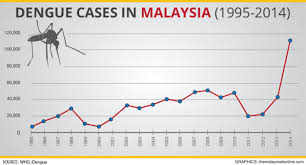
With an average of more than 300 dengue fever cases reported daily in Malaysia, including 329 casesreported yesterday, the Malaysian Health Ministry has seen the case count for the year close in on 75,000 cases to date.
In addition, as of today, 201 fatalities have been reported due to themosquito borne viral disease.More than half of the country’s total have been reported from Selangor state (41,477), followed by 7,719 in Johor and 6,679 cases in Perak state.
Dengue has not been a problem in Malaysia alone. Elsewhere in Southeast Asia, the Philippines and Thailand have both reported 10s of thousands of cases this year.
Thailand has reported 42,900 cases to date, including 35 deaths. Based on the most recent data from epidemiological week 25, the Philippines has reported32,440 suspected and clinically confirmed dengue fever cases, including 105 deaths.
Singapore, which saw record numbers of dengue fever in 2013 and 2014, has seen a decrease in cases so far in 2015 with 5,726 cases reported to date.
Dengue fever is an infectious disease carried by mosquitoes and caused by any of four related dengue viruses. This disease used to be called “break-bone fever” because it sometimes causes severe joint and muscle pain that feels like bones are breaking.
Although the World Health Organization (WHO) says on their recent fact sheet that they currently estimate there may be 50–100 million dengue infections worldwide every year, researchers from the University of Oxford and the Wellcome Trust, using cartographic approaches, estimate there to be 390 million dengue infections per year worldwide.
There are three types of dengue fever in order of less severe to most: the typical uncomplicated dengue fever, dengue hemorrhagic fever (DHS) and dengue shock syndrome (DSS).
There is not a vaccine for dengue fever. There is no treatment for dengue, just treat the symptoms.
http://outbreaknewstoday.com/malaysia-dengue-fever-deaths-top-200/
Monday, 5 October 2015
Dengue Symptoms - Breakbone fever
 |
| picture from http://www.nhp.gov.in/ Information
|
Sunday, 4 October 2015
Facts about dengue that you may not know
Click here if there is no display to the above :Facts about dengue that you may not know
Tuesday, 29 September 2015
Dengue Fever
 |
| Pic from Google |
Dengue fever is a viral disease spread by the bite of infected mosquitoes, Aedes aegypti.
There are four types of viruses that cause dengue fever.
Infection with one of these types of viruses provides protection to only that type for life, so persons living in a dengue-endemic area can have more than one dengue infection during their lifetime.
The disease is now found in more than 100 countries in South and South-East Asia , Africa, the Americas, the Eastern Mediterranean, and the Western Pacific.
Subscribe to:
Posts (Atom)